Sacramento County faces recurring rodent migration cycles driven by seasonal river corridor water levels and dense, mature tree canopies. Roof rats ( Rattus rattus ) and Norway rats ( Rattus norvegicus ) frequently…
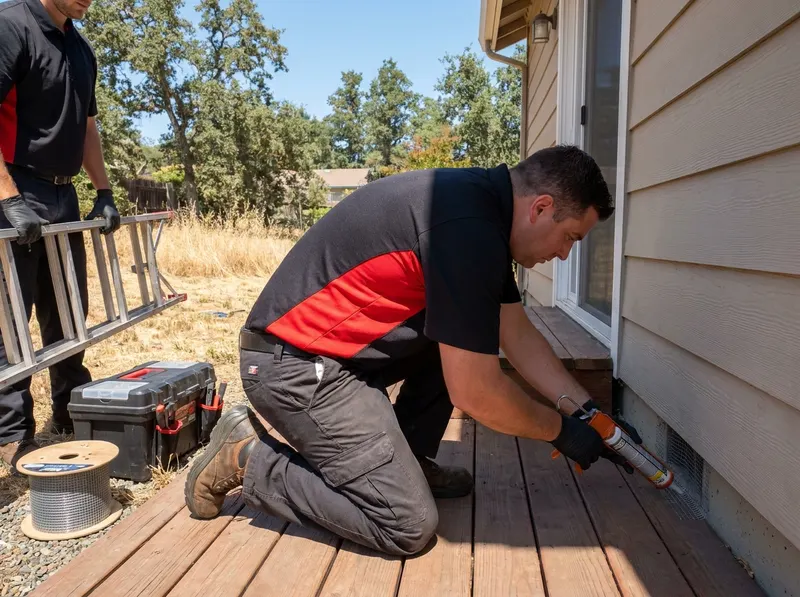
Sacramento County faces recurring rodent migration cycles driven by seasonal river corridor water levels and dense, mature tree canopies. Roof rats (Rattus rattus) and Norway rats (Rattus norvegicus) frequently exploit older architectural details in East Sacramento, Curtis Park, and Midtown, such as uncapped Spanish tile roof gaps, disconnected subfloor crawlspace vents, and unsealed perimeter foundations. Following standards outlined by the Centers for Disease Control and Prevention, physical exclusion relies on non-degradable barriers rather than temporary foams. Openings larger than a standard pencil lead (1/4 inch) allow entry for house mice, while juvenile rats penetrate gaps exceeding 1/2 inch. Rodent exclusion replaces blind toxic bait drenching with durable structural integrity: our team fastens 1/4-inch 23-gauge galvanized steel hardware cloth across crawlspace foundations, installs metal kick plates along weathered garage door gaskets, and mortar-seals plumbing wall penetrations inside utility chases.
Abatement programs run alongside structural repairs to resolve active nests without generating hidden dead-rodent odors inside interior walls. Following structural guidelines from the California Department of Public Health and structural pesticide criteria from the California Department of Pesticide Regulation, snap traps and mechanical capture stations are positioned along mapped perimeter runways, crawlspaces, and attic floor joists. In newer tract builds throughout Natomas and Pocket-Greenhaven, plastic weeping holes and poorly aligned stucco foundation weep screens often permit exterior mice direct access behind wallboard. Applying biological guidelines from the U.S. Environmental Protection Agency on integrated pest management avoids rodenticide drift that threatens neighborhood domestic pets and predatory native raptors living near the American River Parkway.
Long-term structural protection requires addressing the distinct trade-off between exterior architectural modification and structural durability. Sealing attic rooflines on high-pitch vintage homes in Boulevard Park and Land Park requires scaffolding, ridge-vent flashing, and custom-bent metal trim to seal roof-soffit intersections without interfering with building ventilation standards established by the California Energy Commission. Crawlspace restoration, which includes removing soiled fiberglass batt insulation according to safety protocols documented by OSHA and the California Division of Occupational Safety and Health, ensures ambient airborne biological dust stays out of living quarters. For complete regulatory oversight, ProActive Pest Relief coordinates municipal compliance alongside guidelines set by the Sacramento County Environmental Management Department, the national guidance from the National Pest Management Association, and the building requirements maintained by the City of Sacramento Community Development Department.
Every job gets a firm, written price after a free on-site visit.
For standards, safe disposal, and service guidance on PEST CONTROL SEVICE in Sacramento, CA, useful references include U.S. EPA, ENERGY STAR, U.S. Dept. of Energy, Consumer.gov, U.S. Census Bureau, and Google Maps. General consumer and small-business resources are available from USA.gov, Better Business Bureau, FTC Consumer Advice, U.S. Small Business Administration, and Ready.gov.
Tell us about your rodent exclusion and abatement job in Sacramento and we'll send a clear, written quote, usually the same day.
 ProActive Pest Relief